
HAPI
An agentic system built for public safety.
Hapi is a patent-pending agentic system purpose-built for justice, health and social-service contexts. Organizations configure it from a set of capabilities designed around the people, information and operating environment of each deployment.
Hapi can be accessed through SMS, web and tablet, including SMS deployments that do not depend on Wi-Fi or an app.
96%
system accuracy, independently measured across previous deployments
WHAT HAPI ENABLES
Support in the moment. Insight over time.
Hapi connects what people need in the moment with what organizations need to understand over time.
It provides an intelligence layer for navigating complex systems, helping individuals and professionals make sense of changing information, identify relevant pathways and understand what should happen next.
As those interactions occur, Hapi can also create a new source of operational intelligence, helping organizations see patterns in what people need, which resources are being surfaced and where the service landscape may be difficult to navigate.

IN THE MOMENT
Navigate complexity. Move forward.
Finding information is only part of the challenge. Even when trusted resources are brought together in one place, people may not know where to start, what applies to them or what needs to happen first. At the same time, programs, eligibility requirements, hours and intake processes are constantly changing.
Complex needs add another layer. Someone leaving custody may ask about housing, for example, when identification needs to come first because access to housing, income support, banking and employment may depend on having the right documents in place. Hapi also draws on a knowledge base developed specifically for the populations and environments it serves, including the terminology, shorthand and institutional language people actually use. This helps it interpret context that general-purpose language models do not reliably understand.
Hapi adds an intelligence layer to this process, helping individuals and professionals make sense of changing information, understand how needs connect and determine a practical path forward. It goes beyond identifying an option by helping clarify what is required, what to do next and how to get there. Where configured, Hapi can also follow up as circumstances change, helping people continue from one step to the next rather than starting over each time. For individuals, that creates greater autonomy and continuity. For professionals, it provides additional capacity to keep support personal without manually researching the entire resource landscape for every person they serve.
HOW IT WORKS
Four things happen before Hapi sends a single word.
Most tools respond to what a person asks. Hapi considers the fuller picture first: who is this person, what do we already know, what have they tried before, and what has the agency configured Hapi to do or stay out of?
Only then does Hapi respond.

01
Perceive
A message arrives. It might be an SMS from inside a correctional facility, a web query from a professional supporting someone during discharge, or an audio message from someone who has difficulty reading. Hapi can accept different ways of communicating so the channel does not determine who gets access.
SMS
Web
Tablet
Audio
No Wi-Fi required
IN-FACILITY SMS, NO INTERNET
where can i get food when i get out next week
Got it. What city are you releasing to?
edmonton
I'll pull options for Edmonton. Do you have any dietary needs or ID right now?
02
Reason
Before generating a response, Hapi checks what it already knows. That can include relevant conversation history, information flagged by staff, jurisdiction, available resources and the guardrails configured by the agency.
Hapi can also interpret literacy, language and communication cues from how a person writes, including context-specific terminology, shorthand and informal language. It adapts how information is interpreted and presented without changing the substance. Someone returning to Hapi does not have to start from scratch unless they want to.
Conversation memory
Literacy detection
Guardrail enforcement
Jurisdiction awareness
RETURNING USER, SESSION 6
You're back. Last time you were looking at housing near Northside. Did that pan out?
no they were full
Okay. There are two others in the same area that weren't on the list last month. Want me to check current availability?
03
Act
Hapi does not simply suggest a resource and leave the next step to the user. It can find relevant resources, check current information, calculate transportation options, provide practical wayfinding and generate the information needed to move forward.
Where a deployment includes defined safety pathways, thresholds and response processes are configured in advance and communicated to users. System activity is logged according to the requirements of the deployment for review and accountability.
Live resource lookup
Transit routing
Crisis escalation
Audit logging
CONTINUED SESSION*
I'm here. Tell me what's happening with the court date.
k. I’ll go to the bissell centre. What do I need to bring to get ID? I’ve only been at the halfway house a week.
Here’s what you’ll want to bring:
Documents
-
Any government photo ID you have, even an old one
-
Proof of Canadian status
-
Proof of Alberta residence
Don’t have those?
Bring any papers with your name, such as a health card, SIN letter, benefit cheque or shelter letter. Staff can also help with proof of residency if you’re newly housed.
Walk-in service is available until 3 PM. Ask for ID assistance.
From West Edmonton Mall, take Bus 007 toward downtown and get off at 100 St & 103 Ave. From there, it’s a short walk to the Bissell Centre.
What bus should I take now? I’m by West Edmonton Mall.
*Conversation shortened for illustration
04
Follow up
One of the biggest challenges in reintegration and ongoing support is what happens after the initial connection. When the Check-In module is enabled, Hapi can follow up to ask whether a referral led anywhere, whether someone made it to an appointment, or whether another option is needed.
Where human support could be helpful, Hapi can also create a pathway back to staff rather than leaving the person to navigate the next step alone. These pathways are configured with the organization and communicated to users so they understand when and how human support may become part of the interaction.
Proactive check-in
Appointment tracking
Staff alerts
CHECK-IN MODULE, 72HR POST-RELEASE
Hey. You were released three days ago. Did you make it to the housing office?
not yet couldn't find it
I can send directions now. They're open until 5. Want me to also put a reminder for tomorrow morning in case today doesn't work?
"I found it very helpful to plan my steps moving forward. Very straightforward. I really like it."
HAPI PILOT PARTICIPANT, EDMONTON
MODULAR BY DESIGN
Configured around the environment it needs to support.
Hapi combines configurable capabilities that can be adapted to the people, information and operating environment of each deployment.

Check-In
Hapi reaches out first. Tracks whether referrals led anywhere. Flags when someone goes quiet for longer than expected.
Literacy Adjustment
Reads how a person writes and adjusts. Grade 3 to professional level, mid-conversation if needed. Built specifically for FASD and neurodivergent users.
Resource Research
Pulls from live databases, checks current availability, filters by eligibility. No static spreadsheets and with the option for adding in actual verification of resources from the Duologue team.
Wayfinding
Real-time transit routing from wherever the person is located. Sent via SMS so they have it on the bus, not just in the browser tab to close.
Memory
Retains conversation history across sessions and, with permission, across agencies. A person who has used Hapi before does not have to explain their situation from scatch.
Guardrails
Agency-configured rules enforced at the infrastructure layer. What Hapi will say, what it will not say, who it calls when something does wrong. Cannot be overridden mid-conversation.
Translation
Detects language from the first meeting and responds in kind. Covers 40 languages used across Canadian justice and health contexts, including Plains Cree.
Discharge Planning
Structured planning view for staff and a plain-language version for the person releasing. Both update as the plan changes. Designed around the critical windows after release.
HAPI INSIGHTS
Turn navigation activity into a clearer view of the system.
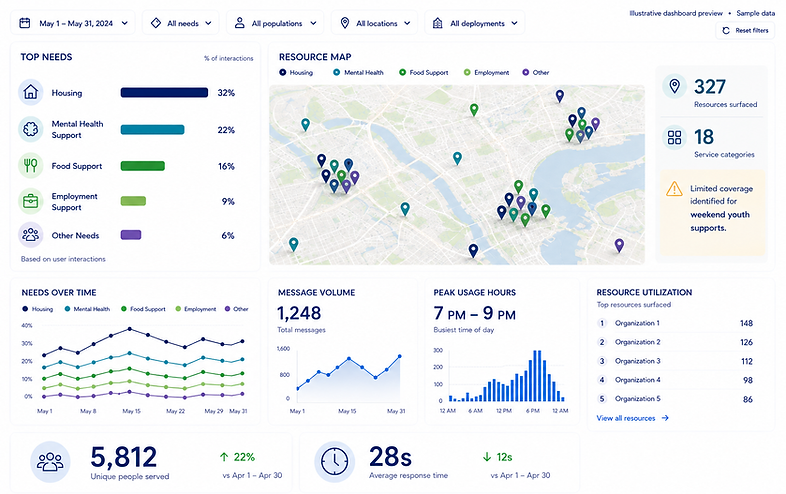
Hapi Insights brings together aggregate patterns from navigation activity to help organizations understand both sides of the equation: what people are trying to navigate and what the resource landscape offers in response. Beyond showing common needs or frequently surfaced resources, organizations can explore how needs change over time, across populations and locations, and during different operating periods.
As navigation activity accumulates, deeper patterns can also begin to emerge. Organizations may be able to see which needs commonly arise first, what people tend to navigate next, where pathways begin to narrow, and what barriers are reported along the way. Looking at those patterns alongside the resources available can provide a more nuanced view of how people actually move through a service system, not simply how many services exist within it.
The depth of insight is configured around each deployment and the information available within it. In some environments, Hapi may provide visibility into needs, resources surfaced and information shared. Where individuals interact with Hapi directly over time, additional patterns may emerge around resources pursued, barriers encountered, changing circumstances and subsequent navigation needs. Insights are designed to surface aggregate patterns while protecting the privacy of the individuals seeking support.Together, these views can help organizations identify questions that warrant deeper investigation and bring additional evidence into planning, coordination, evaluation and reporting.
WHAT MAKES IT DIFFERENT
Most conversational tools in this space were not built for this population.
Many digital tools assume a user has reliable internet access, a smartphone, strong literacy and the ability to navigate conventional interfaces. Those assumptions do not hold equally across the populations and environments Hapi is designed to support. In correctional settings, for example, 57% of people read below a Grade 5 level, while estimates suggest up to 46% of adults involved in the criminal legal system may have FASD. Access to smartphones, data and reliable internet can also be limited or unavailable. Hapi was designed around these realities.
Hapi was designed around these realities.

Configured for each agency before going live
There is no single default Hapi deployment. Before Hapi goes live, the organization defines and approves how it will operate in that environment, including its guardrails, what it will and will not respond to, which modules are active, and where human support pathways are used. Changes to those configurations can be reviewed, approved and versioned as the deployment evolves.
Patent-pending architecture
Hapi's patent-pending architecture brings perception, reasoning, module orchestration and safeguards together in a system designed for complex public-sector and human-service environments. These components work together so Hapi can respond to context, operate within deployment-specific boundaries and support practical action rather than simply generate a conversational response.
Access across different environments
Correctional and other secure environments may have limited or no Wi-Fi access, while outside those settings not everyone has a smartphone or reliable data plan. Hapi can support different channels depending on the deployment, including SMS, web and tablet access, so organizations can choose an approach that fits the people and environments they serve.
Language informed by the people and settings we serve
Hapi has been developed using the language people actually use in the environments it serves, including shorthand, colloquial language, sector-specific terminology and prison jargon. This helps Hapi interpret requests that general-purpose AI systems may misunderstand or miss, while adapting how information is communicated for different literacy levels, populations and contexts.